
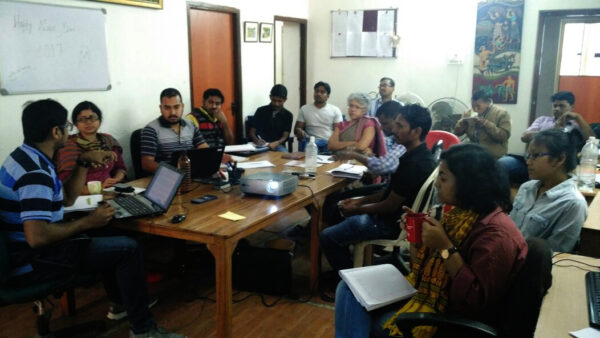
Tapas Singh Modak, Senior Data Analyst, FAS, presented a seminar titled “Tracing Changes in the Groundwater Market: A Case Study of Amarsinghi village, 2005-2015” on January 12, 2017 at the office of the Foundation for Agrarian Studies. The presentation was part of a paper being prepared jointly with Aparajita Bakshi, Assistant Professor, School of Development Studies, Tata Institute of Social Sciences, Mumbai. The paper is based on primary data collected in the village surveys conducted by the Foundation.
The speaker began by pointing out a remarkable shift witnessed across India in the 1970s from irrigation being a subject matter of public works to it becoming an area for private investments. This shift in turn led to the development of an informal ground water market in the country.
Turning the focus to West Bengal, it has been established that the stagnation in agricultural growth till the late 1970s could be largely attributed to the lack of attention towards the development of irrigation in the State. A rapid increase in tubewell irrigation, along with effective government intervention, in terms of rural credit and electrification, led to high agricultural growth in the 1980s. There has, however, been a deceleration in the rate of agricultural growth in West Bengal since the mid 1990s.
Describing the particular case of Amarsinghi village, Maldah district, Tapas focused on the phenomenal shift from diesel powered groundwater irrigation to electrified tubewell irrigation that has taken place in the village in the 2000s. Electrification led to the replacement of shared contracts with fixed water rates, substantially reducing the cost of irrigation in the village. There were, however, significant hurdles in getting the required electric connection for installing the tubewells. These hurdles increased the cost of installation and eventually led to a concentration of ownership of electric tubewells, resulting in a possible monopolisation of the water market. Tapas described in detail some of the efforts made by the big farmers to control the water market in the village.
He then contrasted the scenario with another side of the village with a well functioning cooperative run electric tubewell. In the year 2010, cultivators buying water from the cooperative tubewell made higher profits in paddy (rabi) and potato cultivation than households that bought water from private tubewells. This was due to the significantly lower cost of irrigation of the former. However, by 2015, this advantage could no longer be observed and the profitability of paddy and potato were similar in both cases, despite the difference in the cost of irrigation. Strikingly, the farmers using water from the private tubewell continue to pay high water charges; however, it is observed that they have been economising on other input costs. Tapas argued that there could be a further increase in the water charges due to growing tendencies of monopolisation. The control over water for irrigation also presents an additional danger of worsening the socio-economic inequalities prevailing in the village.
Tapas concluded by pointing out that State intervention in the form of electrification and installation of tubewells in the village can further reduce the cost of irrigation, and in turn, improve profitability for the cultivators.
