
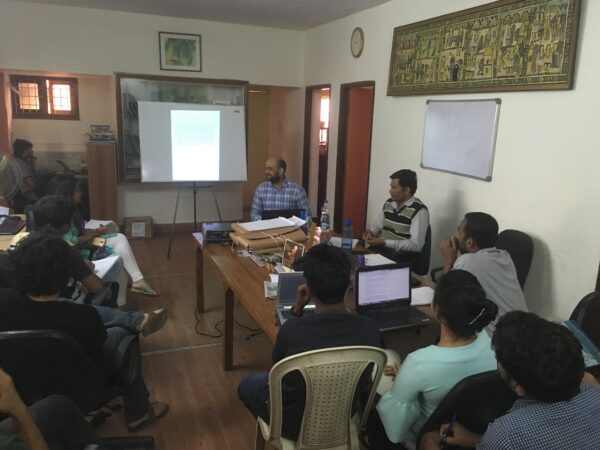
Dr Shamsher Singh, Visiting Scientist at the Indian Statistical Institute, Bangalore presented a seminar titled, “Housing and Labour Relations in Rural Rajasthan: A Case Study of Attached Labourers,” on February 20, 2018, at the office of the Foundation. The presentation discussed the features of attached labour in 25F Gulabewala village, Sri Ganganagar District, Rajasthan. The village was surveyed by FAS under the Project on Agrarian Relations in India in 2007.
The main castes in the village are Jat Sikh, Mazhabi (Dalit) Sikh, and Nayak (Dalit). The village is marked by extreme inequality in terms of class and caste. Dalit households constituted about 60 per cent of the village and almost all of them were landless. Only three Dalit households, out of a total of 123 Dalit households resident in the village, owned agricultural land. At the other end of the distribution, Jat Sikh households owned almost all arable land in the village. The inequality in land ownership in turn led to relationships of dependency between Dalit workers and their Jat Sikh employers.
Shamsher’s research explores the characteristics of these relationships. The study shows the persistence of two kinds of attached labour in the village, i.e. “siri” and “naukar.” Indebtedness was the main mechanism through which the phenomenon of attached labour continued to persist. The study also depicted how housing provided by the landowners were another means to increase the dependency of the labourers.
Curiously, this is a village that has benefited from high levels of capitalist development. However, as the study showed, vestiges of pre-capitalist relations of production continue to prevail in the village, pointing, perhaps, to contradictions in the development of capitalism in the Indian countryside.
The presentation was followed by an extensive discussion among the participants.
